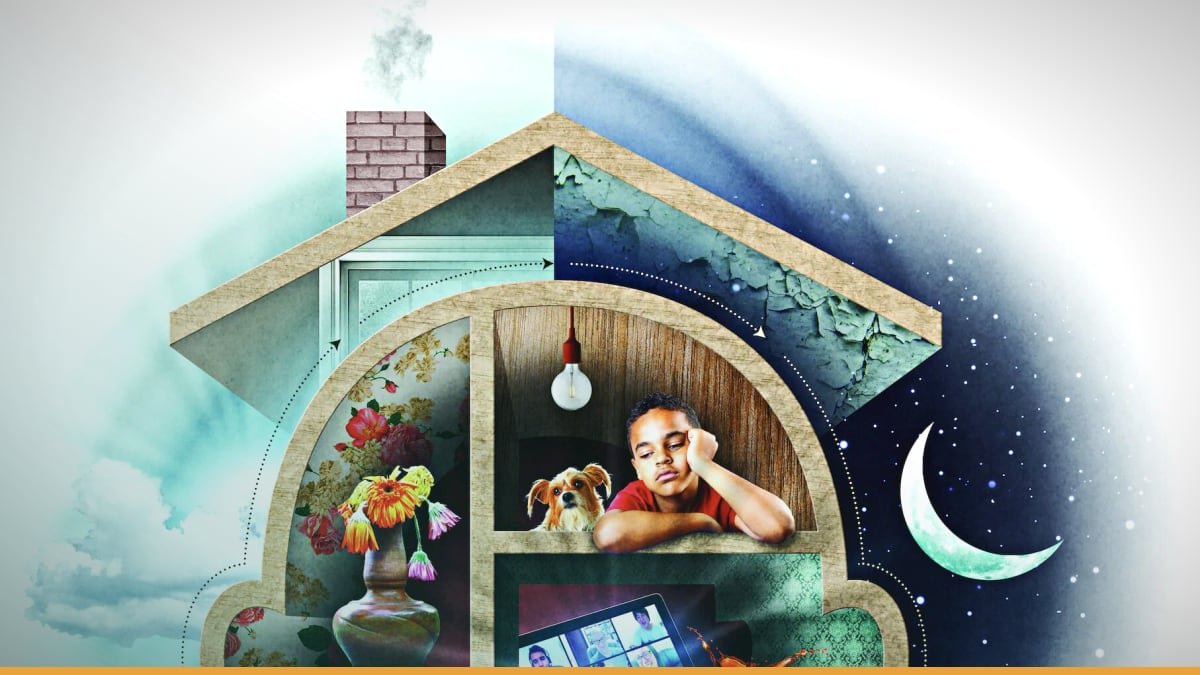
Header image source: What Does Home Mean to Us? Not the Same Thing It Did Before the Pandemic – The New York Times via The New York Times via Google — cropped to 16:9 and colour-adjusted.
Key takeaways
- Home lowers cortisol and activates the parasympathetic nervous system.
- Home serves as a mental schema that shapes memory and future aspirations.
- Technology mimics home functions through smart devices and virtual spaces.
Home lowers cortisol. It encodes memory. It turns a house into a psychological operating system. Merriam-Webster calls it "one’s place of residence" and "the social unit formed by a family living together. " Habitat for Humanity describes home as a safe haven and comfort zone where aspirations take shape. Schlage’s research describes home as a place where people regroup from negative experiences. Wikipedia notes homes provide sheltered spaces for sleeping, eating, and hygiene. The phrase "home in" isn’t just a metaphor—it describes the gravitational pull of a place that orients you when everything else feels unstable.
This isn’t abstract. These functions are measurable, universal, and baked into how humans survive.
The Biological Imperative: Why Home Isn’t Optional
Home’s most basic job is physiological. It’s where you sleep, eat, bathe—domestic activities Wikipedia lists as essential. But its biological role runs deeper. Schlage’s research describes home as a place where people feel safe and comfortable, a retreat that lowers stress after bad days. That’s not just sentiment. Safe environments activate the parasympathetic nervous system, dropping heart rate and blood pressure. Poor housing—noise, temperature swings, crowding—disrupts circadian rhythms and impairs cognition. Territorial control, the ability to personalize and defend a space, fulfills a deep-seated need for autonomy linked to lower anxiety.
Sleep is the clearest example. Homes provide dedicated spaces for rest, a biological necessity. Studies show people sleeping in unstable or unsafe environments have higher cortisol, weaker immune function, poorer emotional regulation. Home isn’t just where you can sleep—it’s where your body expects to sleep, lowering its guard enough to enter deep, restorative cycles. Hygiene works the same way. Domestic spaces enable sanitation practices that reduce disease transmission. Without home, these basic needs become harder to meet, with cascading effects on health.
The Psychological Dimension: Home as Mental Software
Home isn’t just physical. It’s a cognitive schema. Merriam-Webster’s definition—"one’s place of residence"—reflects how it serves as a mental shortcut for "" This schema shapes spatial memory, navigation, even how we process new information. Disoriented in a new city? Your brain defaults to "home" "home in").
But home isn’t just about the past. It’s a canvas for the future. Habitat for Humanity’s research reveals people use their homes to build future aspirations, whether through renovations, decor, or real estate choices. A spare room becomes a home office, signaling a career shift. A nursery gets painted before a baby arrives, projecting a new identity. Even moving—choosing a neighborhood, a floor plan, a style—is aspirational projection. Home isn’t static. It’s a dynamic record of who you were, who you are, and who you hope to become.
The Social Contract: How Home Structures Relationships
Home isn’t just about individuals. Merriam-Webster defines it as "the social unit formed by a family living together," emphasizing cohabitation and interdependence. Domestic spaces assign social scripts: parent, child, guest. These scripts shape behavior. A dinner table enforces norms about conversation and sharing. A living room dictates who sits where, who controls the remote. Even a home’s physical layout—open-plan vs. compartmentalized—reflects and reinforces social dynamics.
Home also regulates access. Doors, thresholds, locks create boundaries between "insiders" and "outsiders. " Schlage’s research highlights home’s role as a "safe haven," a place to retreat from social demands. But these boundaries aren’t just physical. Inviting someone into your home is an act of trust. Keeping them out is a declaration of privacy. The concept of home raises questions about its effects on individuals versus families.
Cultural variability complicates this. While home’s functions are universal, its expression varies widely. Extended families in multigenerational households blur lines between individual and collective space. Nomadic groups carry their "homes" with them, redefining permanence. Digital nomads, untethered from physical locations, create rituals—a favorite coffee shop, a VPN—to simulate stability. The social contract of home adapts, but its core purpose—structuring relationships—remains.
The Digital Echo: How Technology Mimics Home
Technology doesn’t just borrow the word "home. " Websites and apps use "homepages" as navigational baselines, leveraging the brain’s preference for familiar starting points. Smart homes—automated lighting, thermostats, security systems—replicate home’s stress-regulating functions. A Nest thermostat doesn’t just control temperature. It creates an environment that adapts to your needs, much like a well-designed physical home.
Virtual worlds take this further. Games like Animal Crossing let players "build" homes, reflecting the human drive to create personal sanctuaries. Platforms like Second Life offer digital real estate, where users decorate virtual spaces and host gatherings. These aren’t just distractions. They’re attempts to fulfill the same psychological needs as physical homes. The concept of home raises questions about its definition and effects. The answer isn’t simple. A VR living room can’t provide the biological benefits of a real one—sleep, hygiene—but it might offer a sense of belonging or aspiration. The "Home" key on your keyboard won’t lower your cortisol, but it does provide a predictable foundation in a chaotic digital landscape.
When Home Fails: The Cost of Disruption
Home’s functions aren’t optional. When they break down, the consequences are severe. Homelessness—absence of a permanent residence—correlates with increased cortisol, reduced life expectancy, disrupted social bonds. Refugees and migrants report "identity fragmentation" when separated from home, struggling to rebuild continuity. Poor housing—crowding, mold, lack of privacy—impairs cognitive function and increases family conflict. These aren’t inconveniences. They’re systemic failures with measurable human costs.
Consider digital homelessness. The Lenovo metaphor of the "Home" key highlights this: without a default state to return to, users are perpetually disoriented. The same applies to physical spaces. A child raised in unstable housing shows lower academic performance and higher anxiety. A family in crowded conditions experiences more conflict. Home’s absence doesn’t just create discomfort. It erodes the foundations of wellbeing.
The Future of Home: AI, Climate, and Work Are Redrawing Its Boundaries
Home isn’t static. Emerging trends are redefining its functions. Remote work blurs the line between domestic and professional spaces, forcing new definitions of "residence. " Climate migration is making "home" more fluid, with temporary or modular housing gaining prominence. AI cohabitation—voice assistants, robots like Amazon Astro—is altering social dynamics within homes. Younger cohorts increasingly view home as a financial asset (Airbnb) rather than a permanent sanctuary, challenging traditional definitions.
Smart homes are a case study in this evolution. A Nest thermostat doesn’t just regulate temperature. It learns your routines, creating a personalized environment. A robot vacuum doesn’t just clean. It becomes a "domestic actor," altering how families interact with space. These technologies replicate home’s functions—safety, comfort, control—but they also introduce new questions. Will AI companions eventually replace human cohabitation as a source of comfort? Can a smart home provide the same psychological benefits as a physical one?
Climate change is another disruptor. As extreme weather displaces communities, "home" may become more transient. Modular housing, co-living spaces, floating homes are gaining traction. These adaptations challenge the traditional definition of home as permanent and fixed. But they also highlight its resilience. Home’s functions—shelter, safety, belonging—persist, even as its forms evolve.
The Unanswered Questions: What We Still Don’t Know
For all we know about home, gaps remain. How do we quantify "hominess"? Schlage’s research describes home as a place of comfort, but what makes a space feel like home? Scent? Layout? Familiarity? Can we measure it, or is it inherently subjective? The concept of home raises questions about its definition. What can we learn from cultures where home is portable, shared, or temporary? Could their models inform solutions for modern housing crises?
Digital permanence is another open question. Can virtual spaces—VR homes—fulfill the same psychological needs as physical ones? A Second Life apartment might offer belonging, but it can’t provide the biological benefits of sleep or hygiene. Will future generations blend physical and digital homes seamlessly, or will the distinction remain? And what about AI? Will robots or voice assistants become "family members," altering the social contract of home? Or will they remain tools, unable to replicate the depth of human cohabitation?
Home isn’t just a place. It’s a technology—an evolved tool for survival, adaptation, and meaning. Its functions are universal: shelter the body, restore the mind, anchor identity, encode memory, structure relationships. But its forms are endlessly adaptable, from caves to smart apartments to digital interfaces. The evidence suggests home’s most critical role is to provide a predictable foundation from which humans can explore, create, and connect.
As technology and society evolve, so will home. But its core purpose will likely endure. The "Home" key on your keyboard, the smart thermostat in your living room, the VR apartment in your headset—these are just new expressions of an ancient need. Without it, we’re adrift. With it, we’re home. The question isn’t whether home will change. It’s whether we’ll recognize it when it does.