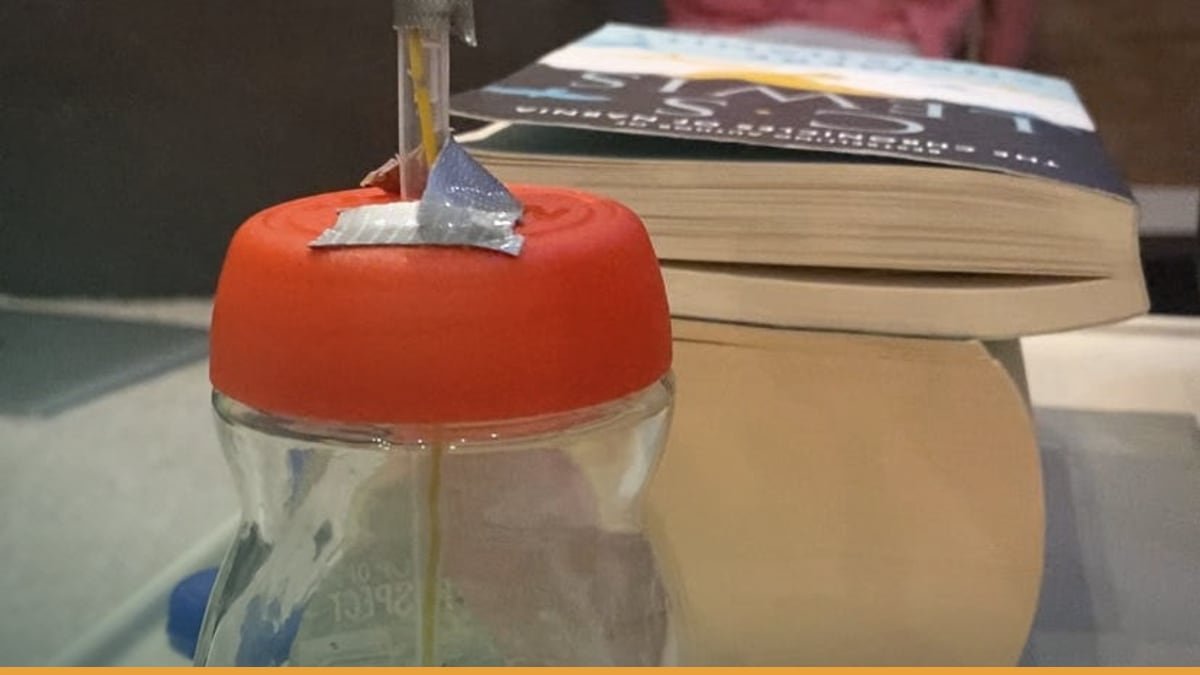
Header image source: Coulomb’s law remains tricky to test at home via Casual Physics Enjoyer – Substack via Google — cropped to 16:9 and colour-adjusted.
Key takeaways
- Home setups can’t generate consistent static charge or isolate it from humidity
- Electrostatic forces are too tiny for kitchen scales to detect reliably
- Professional experiments use vacuum chambers and interferometry for 1 part in 10⁹ precision
Two metal balls. A ruler. A sensitive scale. That’s the shopping list for verifying Coulomb’s law—the inverse-square rule that tells you how electric charges push and pull. The equation looks like child’s play: F = k q₁q₂ / r². Double the distance, quarter the force. Done.
Except it’s not done. Not even close.
A physics enthusiast is trying to design a home experiment to test Coulomb’s law. They hit a wall before the first measurement. Not because the math was hard. Not because the concept was tricky. Because charge—actual, measurable, consistent charge—refused to cooperate. Rubbing a metal ball with wool or plastic generates static, sure. But how much? How consistent? How long does it last before leaking away? None of these questions have reliable answers outside a lab. And when professional experiments confirm the inverse-square relationship to 1 part in 10⁹, unpredictability isn’t just a nuisance. It’s a dealbreaker.
This isn’t just a story about a failed DIY project. It’s a lesson in why even the most "basic" physics experiments demand precision that home setups can’t touch. And what that gap says about how science actually works.
The Illusion of Simplicity
Coulomb’s law looks tailor-made for a home experiment. The equation is clean. The materials seem simple: aluminum foil, metal spheres, a ruler. Historical precedent exists—Coulomb himself used a torsion balance. So why doesn’t it work at home?
Because the devil lives in the details. Coulomb’s original experiments weren’t just clever. They were controlled. His torsion balance didn’t just measure force—it amplified it. A thin wire twisted by tiny electrostatic forces, with the angle of deflection read through a microscope. Try improvising that with a rubber band and a protractor.
Modern experiments take precision further. Professional experiments have confirmed Coulomb’s law to within 1 part in 10⁹. It didn’t. But achieving that required extreme precision and controlled conditions. None of which are kitchen-friendly.
At home, you’re stuck with static cling and a ruler.
The Charge Problem: Why Your Metal Ball Betrays You
The first hurdle is generating repeatable charges. Rubbing a metal ball with wool or plastic might create a spark, but the amount of charge transferred is anyone’s guess. Household materials—aluminum foil, copper wire, even "conductive" metal spheres—are riddled with inconsistencies. Oxidation layers, dust, surface contaminants. Humidity in the air acts like an invisible conductor, siphoning charge away before you can measure it.
In a lab, charges are isolated. Faraday cages block external fields. Ion beams or charge division techniques let researchers dial in exact amounts of charge. At home? You’re at the mercy of whatever static you can scrape together.
Even if you manage to charge your metal ball, keeping it charged is another battle. Air humidity above ~30% starts leaking charge away in seconds. Most homes hover around 40–60% humidity—enough to sabotage any attempt at consistency. Some DIYers try desiccants or dehumidifiers, but these introduce new variables: temperature gradients, air currents, or the desiccant itself acting as a conductor.
Professional labs don’t just control humidity—they eliminate it. Experiments run in dry nitrogen or vacuum chambers, where charge leakage is negligible. At home, your charged balloon sticks to the wall for a few minutes, if you’re lucky.
Measuring Tiny Forces: Why Your Kitchen Scale Is Useless
Even if you solve the charge problem, you’re not out of the woods. The forces involved in Coulomb’s law are tiny. Two 1 nC charges separated by 1 cm exert a force of about 90 micronewtons. For context, that’s roughly the weight of a single human eyelash. Your average kitchen scale maxes out at grams, not micrograms. Improvised pendulums or torsion balances made from thread and straws might detect something, but the signal drowns in environmental noise.
Coulomb’s torsion balance worked because it amplified the force. A tiny electrostatic push twisted a wire, and the angle of twist was read through a microscope. Try replicating that with a laser pointer and a mirror taped to a soda can. Even if you could, alignment errors and calibration drift introduce uncertainties that swamp the measurement.
Environmental noise is another killer. Vibrations from footsteps, air currents from an open window, or the electrostatic field from a nearby charged sweater can distort results. In a lab, these variables are controlled or eliminated. At home, they’re the background radiation of daily life.
The Inverse-Square Test: Why Distance Measurements Lie
Here’s where things get really tricky. Coulomb’s law predicts that force should scale with 1/r². To test this, you’d plot force against distance on a log-log graph and look for a slope of -2. Sounds straightforward. It’s not.
First, there’s the problem of probe size. Coulomb’s law assumes point charges, but your metal ball isn’t a point—it has a radius. At small separations, the distance r isn’t just the distance between the centers of the balls. It’s the distance between their surfaces. If your balls are 1 cm in radius, and you try to measure the force at 1 cm separation, you’re already violating the point-charge assumption. The inverse-square relationship breaks down.
Then there’s alignment. If your two charged balls aren’t perfectly aligned, the force you measure isn’t F = k q₁q₂ / r²—it’s F cos(θ), where θ is the misalignment angle. A few degrees of error might seem minor, but at small distances, it’s enough to skew your results.
Finally, there’s the resolution of your distance measurement. A ruler gives you millimeter precision. That’s fine for measuring the length of a book, but it’s useless for detecting small deviations from r⁻². Professional experiments use interferometry or piezoelectric actuators to control and measure distances with nanometer accuracy. At home, you’re stuck with whatever you can eyeball.
The Symmetry Problem: Why Two Charges Aren’t Enough
Coulomb didn’t just measure the force between two charges. He also verified that the force was symmetrical—that swapping the charges didn’t change the result—and that it scaled linearly with the charge on each sphere. This is critical for confirming the q₁q₂ term in the equation.
At home, you have no way to systematically vary charge. Rubbing two objects together rarely imparts identical charges, and there’s no easy way to "halve" a charge for controlled experiments. In a lab, researchers use Faraday cups or charge division techniques to precisely control q₁ and q₂. At home, you’re limited to whatever static you can generate.
Then there’s the problem of polarization. Nearby conductors—like a metal table or even your own body—can induce image charges, distorting the field between your test charges. In a lab, these effects are shielded or accounted for. At home, they’re just another source of error.
What Can You Test at Home? (And Why It Still Matters)
So is there anything you can do at home to explore Coulomb’s law? Yes—but the goal shifts from verification to demonstration.
Qualitative observations are still possible. These experiments won’t confirm the inverse-square law, but they’ll give you a feel for how static electricity behaves.
For something semi-quantitative, try measuring deflection angles with a smartphone camera. A charged pendulum—a metal ball on a thread—will deflect in the presence of another charge, and you can use image analysis to track the angle. It’s not precise, but it’s a start.
The real value of these attempts isn’t in the results. It’s in the process. Struggling with Coulomb’s law at home teaches you why physics relies on controlled conditions, precision tools, and systematic error analysis. It’s a reminder that what looks simple on paper is often brutally complex in practice.
How the Pros Do It: Precision at Any Cost
Professional experiments don’t just confirm Coulomb’s law—they stress-test it. Professional experiments have confirmed the inverse-square relationship to 1 part in 10⁹. If the exponent in r⁻² deviated even slightly, a current would flow. It didn’t.
To achieve this, they needed highly controlled laboratory conditions.
Some experiments test Coulomb’s law at various scales. The precision isn’t just academic. It’s a way to probe the limits of our understanding.
At home, you’re lucky if you can measure the force between two charges at all. In a lab, they’re measuring the absence of a force to one part in a billion.
The Bigger Picture: Why Home Experiments Still Matter
So why bother trying to test Coulomb’s law at home? Because the struggle is valuable.
The tradition of "kitchen physics" runs deep. Galileo rolled balls down inclined planes. Faraday built motors from wire and magnets. These weren’t just demonstrations. They were the foundations of modern physics. The fact that Coulomb’s law resists home verification doesn’t diminish its importance. It highlights the gap between intuition and precision.
Even failed attempts teach lessons. They force you to think about experimental design, error propagation, and the limits of measurement. They show why science relies on controlled conditions—and why those conditions are so hard to replicate outside a lab.
And then there’s the role of simulation. While home experiments hit walls, computational tools like finite-element simulations let amateurs explore electrostatics virtually. You can’t measure Coulomb’s law with a ruler, but you can model it on your laptop. That’s not the same as hands-on experimentation, but it’s a way to engage with the physics.
The real question is whether the gap between home and lab can ever be bridged. Or is this one experiment destined to remain a lab-only verification?
Either way, the attempt is worth it. Because the moment you try to measure F = k q₁q₂ / r² at home is the moment you realize just how much precision hides behind that simple equation. And how much we take for granted when we call something "basic. "